Embedded systems, MCUs, microprocessors and FPGAs
Embedded systems
Section titled “Embedded systems”Embedded systems are a class of computing systems in which hardware and software are tightly coupled, usually designed for dedicated functionality.
Usually these systems are designed to be part of a larger system, called the embedding system.
Many of these systems have constraints, such as having to respond to an input within a fixed amount of time (real time).
Microcontroller vs. microprocessor
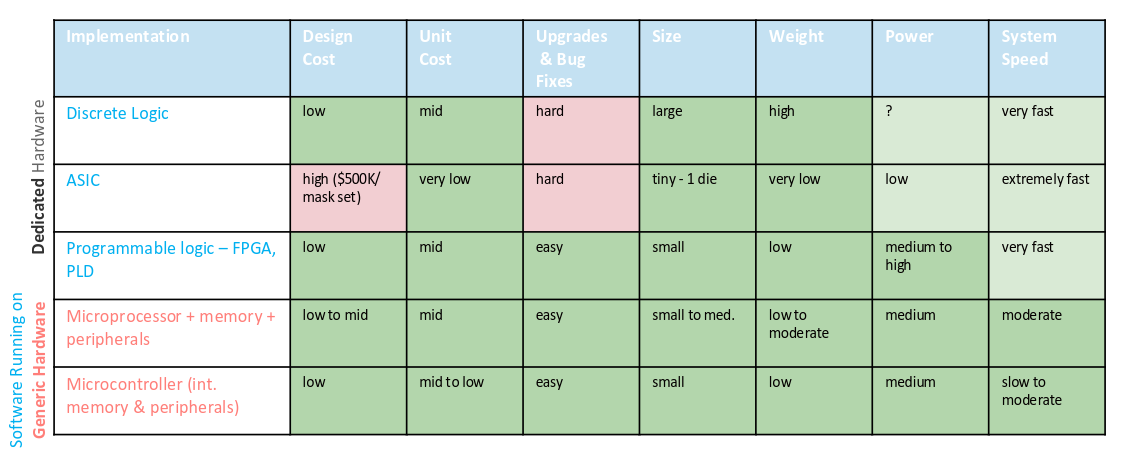
Section titled “Microcontroller vs. microprocessor”A microcontroller (MCU) is a unit that integrates a typically single-core processor, memory blocks, digital and analog I/Os and other basic peripherals.
A microprocessor is specialized for computing and offloads other functions to peripherals such as external RAM, SSD storage or USB devices. It is usually more powerful than a microcontroller.
Field-Programmable Gate Arrays (FPGAs) are an alternative to microcontrollers. They consist of an array of logic cells that can be programmed to become compute, RAM or I/O blocks using a hardware description language (HDL).
Microcontrollers in embedded systems
Section titled “Microcontrollers in embedded systems”MCUs fit naturally in the embedded computing domain: they require low development and manufacturing costs, they offer enough performance to execute most control tasks, and they have low power consumption and effective sleep modes.
Concurrency
Section titled “Concurrency”Peripherals can execute concurrently with the CPU. They signal the completion of their work through the interrupt controller and transmit data through one or more system buses.