End-effector pose and Denavit-Hartenberg frames
Pose of the end-effector
Section titled “Pose of the end-effector”Given a fixed frame attached to the base and another frame attached to the end-effector, the pose of the latter is given by the homogeneous transformation matrix , where is the -vector of joint variables.
, , are the unit vectors associated with the end-effector and are chosen according to its geometry. For a two-fingered gripper, is chosen in the approach direction, in the sliding direction, and is orthogonal to the other two so that the frame is right-handed.
Open chains
Section titled “Open chains”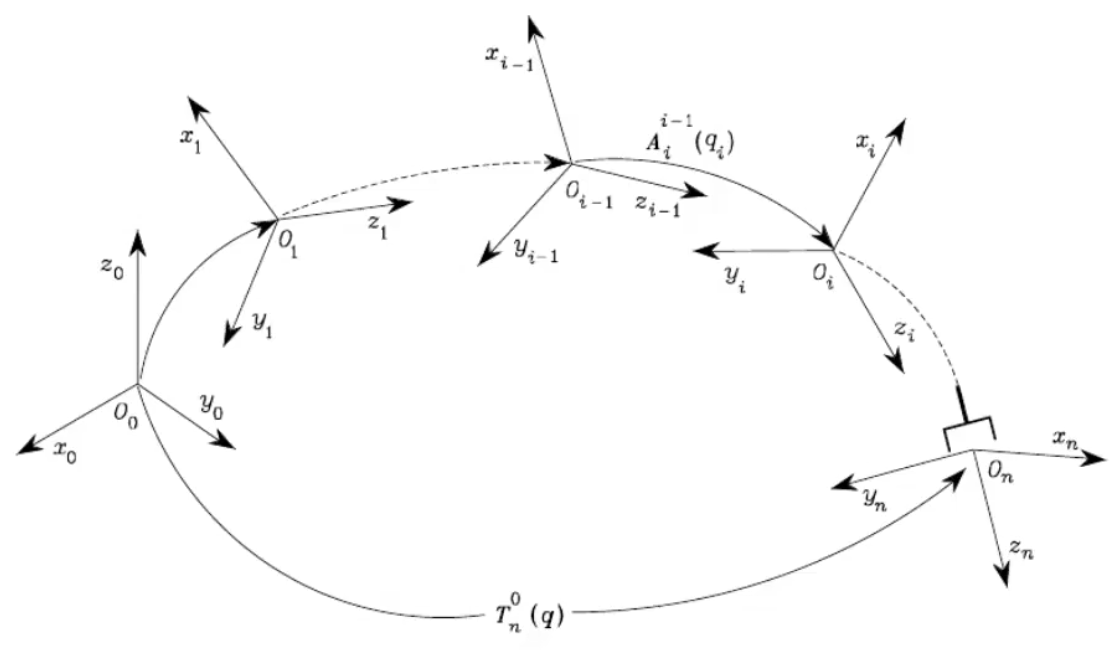
In the general case, we have an open chain of links connected by joints (no loops between links).
By attaching a frame to each link, the pose of frame is determined from the pose of frame , so finding the pose of the -th link is a recursive process starting from the base frame.
Denavit-Hartenberg convention
Section titled “Denavit-Hartenberg convention”In order to find the direct kinematics of an open chain, we need an effective way to place the different frames.
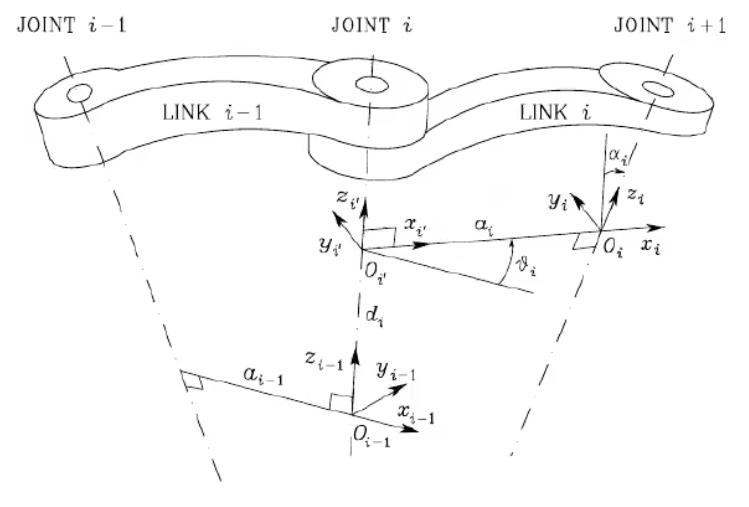
The Denavit-Hartenberg convention proposes the following solution: frame is attached to link , and its axis is chosen aligned with the axis of joint . We still have to choose and the axes and .
The common normal to two lines is the line containing the minimum-distance segment between them. It is uniquely defined when the lines are not coplanar; there is an infinite number of common normals when the lines are coplanar and parallel; and it degenerates to a single point when the lines are coplanar and intersect.
- The origin is placed at the intersection between the common normal and the axis , and at its intersection with the axis .
- is chosen along the common normal in the direction from to .
- is chosen so that the frame is right-handed.
For frame , only is specified, so its origin and -axis can be arbitrary. For frame there is no joint , so is not uniquely defined; since joint is revolute, is aligned with .
We introduce the following parameters:
- : distance between and ;
- : coordinate of along ;
- : rotation angle between and about ;
- : rotation angle between and about ;
Construction of the transformation matrix
Section titled “Construction of the transformation matrix”To build the transformation matrix between link and link :
We start from frame and translate it by along and rotate it by about , aligning it with frame .
Then we translate frame by along and rotate it by about , aligning it with frame .
The end result is: