Operating system protection and access control
OS protection
Section titled “OS protection”In a protection model, a computer consists of a collection of objects, either hardware or software. Each object has a unique name and can be accessed through a well-defined set of operations.
A protection domain defines the set of resources that a process or entity can access, along with the types of operations it may perform on those resources.
Domain switching
Section titled “Domain switching”A process normally executes within the protection domain of the user who started it. Some operations require privileges not normally available to that user.
Such switches must be limited, explicit, and auditable.
Three commonly used approaches are:
setuid: if a special permission bit is set on an executable, the process can run with UID even when invoked by user .su: a command that allows a user to temporarily switch to another user’s full domain. It typically requires the target user’s password.sudo: a command that allows users to execute specific commands as root or another specified user.
Hardware-enforced protection
Section titled “Hardware-enforced protection”Protection rings implement protection domains at the CPU privilege level. Rings are usually named from 0 (most privileged/trusted) to the highest number (least privileged/trusted).
To perform a privileged operation, the application code must use the syscall instruction. The CPU switches to kernel mode and jumps to a predefined entrypoint. The kernel checks permissions and performs the operation.
Access matrix
Section titled “Access matrix”An access matrix is used to represent permissions at a granular level. It formalizes the relationship between subjects (who wants to access) and objects (what is being accessed), defining specific access rights.
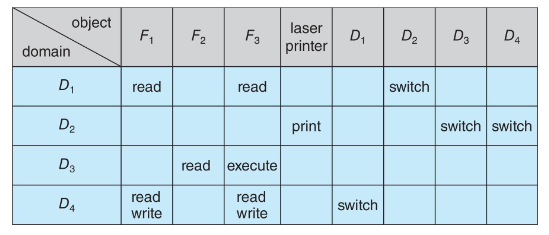
Domains can also be objects to support setting permissions for domain switching.
Generally, the matrix is sparse, so storing every possible combination would be wasteful. Four data structures are typically used:
Global table: stores ordered triples of (domain, object, rights-set). To evaluate an operation, the entire table must be searched.
Access list for objects: each column is implemented as an access list for one object. To evaluate an operation, the object’s list is consulted to check whether it contains the requesting domain and rights-set pair.
Capability list for domains: like the access list, but domain-oriented. A capability list contains (object, rights-set) pairs for each domain.
The list is associated with the domain but cannot be read or modified by the domain itself. A process must request access via syscalls, and the kernel verifies the request by consulting the list.
Lock-key: each object has a list of unique bit patterns called locks, and each domain has a list of patterns called keys. A process in a domain can only access the object if it possesses the matching key.
ACLs and capability lists are the two most common implementations.
Modern protection mechanisms
Section titled “Modern protection mechanisms”Linux capabilities
Section titled “Linux capabilities”Capabilities extend the traditional UNIX model of privileged vs. unprivileged users. The root privilege is split into smaller units and a process can be given only the privileges that it needs.
Each process has the following capability sets:
- permitted: capabilities that the process is allowed to make effective;
- effective: capabilities currently active and enforced by the kernel;
- inheritable: capabilities that are preserved across
exec();
Seccomp
Section titled “Seccomp”Seccomp (secure computing mode) acts as a firewall for system calls and can also inspect their arguments.
A policy is installed per process, defining which syscalls are permitted. The kernel checks each call against the policy.
It is widely used in containers, sandboxes, and browser isolation to reduce the attack surface in untrusted environments.
#include <stdio.h>
#include <unistd.h>
#include <seccomp.h>

int main() {
    // Allow all syscalls by default.
    scmp_filter_ctx ctx = seccomp_init(SCMP_ACT_ALLOW);

    // Kill the process if getpid is called.
    seccomp_rule_add(ctx, SCMP_ACT_KILL_PROCESS, SCMP_SYS(getpid), 0);

    seccomp_load(ctx);

    printf("loaded policy");

    getpid();

    printf("you shouldn't see this");

    return 0;
}

// Compile with gcc <source> -lseccomp
Code signing
Section titled “Code signing”Code signing allows a system to verify the origin and integrity of a program by using a cryptographic signature that the developer applies to the executable.
If the code is modified, the signature becomes invalid, and some systems will disallow execution.