Memory management and address translation
Memory
Section titled “Memory”Computer memory can be seen as a large array of bytes. Every byte has its own address, allowing specific locations to be accessed directly.
The CPU drives computation by fetching instructions sequentially from memory. The Program Counter holds the address of the next instruction to be fetched. Occasionally, fetched instructions indicate that more interaction with memory is needed:
- Fetch: retrieve the instruction bytes from the memory address pointed to by the PC;
- Decode: determine the operation to be performed and its operands;
- Fetch operands: optionally, there may be a requirement to load more data from memory;
- Execute: perform the specified operation on the operands;
- Store result: optionally, the result may need to be stored back to memory;
The memory peripheral does not distinguish between data and operations. It supports only load and store operations.
Address binding
Section titled “Address binding”Address binding is the process of transforming program addresses into actual memory addresses.
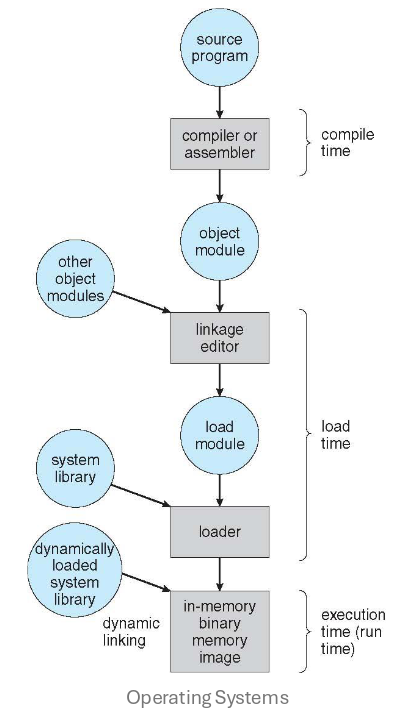
It can happen at three different stages:
- Compile time: the memory location of the program is known before execution. The compiler generates absolute addresses. This is often used in bare-metal embedded systems.
- Load time: the memory location is chosen when the program is loaded into memory. The loader fixes the addresses, and the process cannot be moved.
- Execution time: the memory location can change during the execution of the program. Addresses are virtual and the hardware translates them to physical addresses.
Memory protection
Section titled “Memory protection”The most basic form of memory protection uses a pair of base and limit registers to define the logical address space of a process.
For every memory access (in user mode), the CPU must check that the requested address falls within the [base, base + limit) range.
The memory management unit (MMU) is a hardware device that maps virtual to physical addresses.
- Virtual (or logical) addresses: seen by the program;
- Physical addresses: seen by the memory hardware;
In the protection example above, the MMU converts the offset from the base register into a full physical address. On every context switch, the CPU must update the base register with the address of the program allowed to execute.
Memory allocation strategies
Section titled “Memory allocation strategies”Contiguous allocation
Section titled “Contiguous allocation”In contiguous allocation, the OS reserves a part of the memory for itself (usually low or high address numbers) and leaves the rest for programs.
When a process requires memory, the OS allocates a partition of the required size. This creates holes in memory once processes are released.
Allocating a partition from the list of free holes can be done in various ways:
- First fit: allocates the first hole that is big enough.
- Best fit: allocates the smallest hole that is big enough.
- Worst fit: allocates a portion of the largest hole.
Fragmentation
Section titled “Fragmentation”There are two categories of problems generated by the contiguous allocation strategy:
- external fragmentation: total free memory exists to satisfy a request, but it is not contiguous;
- internal fragmentation: occurs when the allocated memory is slightly larger than requested (e.g., two partitions allocated, but the second is mostly unused);
Paging
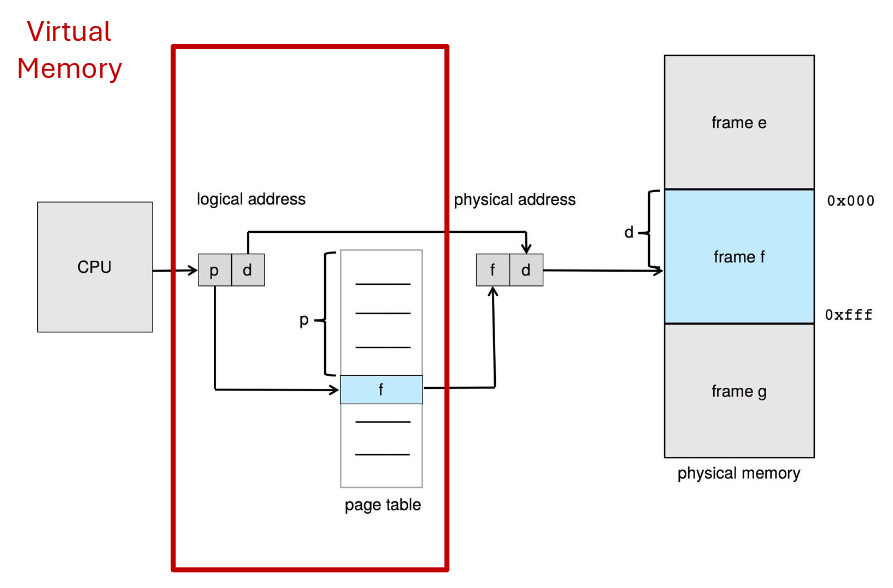
Section titled “Paging”Paging is the subdivision of physical memory into fixed-size blocks called frames. Logical memory is divided into blocks of the same size called pages.
A per-process page table is set up to translate logical to physical addresses.
Paging eliminates external fragmentation, but internal fragmentation can still occur.
Virtual addresses
Section titled “Virtual addresses”A virtual address is made up of 2 parts:
- Page number: used as an index into the page table, which contains the base address of each page in physical memory.
- Page offset: added to the base address to identify the specific byte requested in physical memory.
Page table
Section titled “Page table”The page table is stored in the main memory. The CPU has a special register, called Page-Table Base Register (PTBR) that holds the physical address of the page table.
Modifying the register or the page table is a privileged operation. Processes must request address space changes via system calls such as mmap.
Each page table entry typically includes:
- the physical frame number;
- protection bits: read, write and execute permissions;
- valid/invalid bit: indicates whether the page can be accessed by the process (triggers a segmentation fault if invalid);
- present/absent bit: indicates whether the page is in RAM (triggers a page fault if absent);
- dirty bit: indicates whether the page has been modified;
- reference bit: indicates whether the page has been accessed recently;