SIMD and MIMD architectures: arrays and vectors
From one datapath to parallel architectures
Section titled “From one datapath to parallel architectures”Basic processor design includes one control unit that controls one datapath. In typical SIMD architectures, a single control unit operates multiple datapaths, enabling the application of the same instruction to multiple data registers. MIMD architectures split the control unit, making each processing element independent.
SIMD architecture
Section titled “SIMD architecture”The SIMD architecture allows performing parallel operations in an energy-efficient way, since only one instruction has to be fetched per set of data registers.
Execution is synchronous and deterministic, since the operation performed on each datapath takes the same amount of time.
SIMD machines can be array processors, which employ several processing elements (multiple datapaths) that operate in parallel, or vector processors, which apply a single vectorized instruction to a vector register that holds multiple data elements.
Array architectures
Section titled “Array architectures”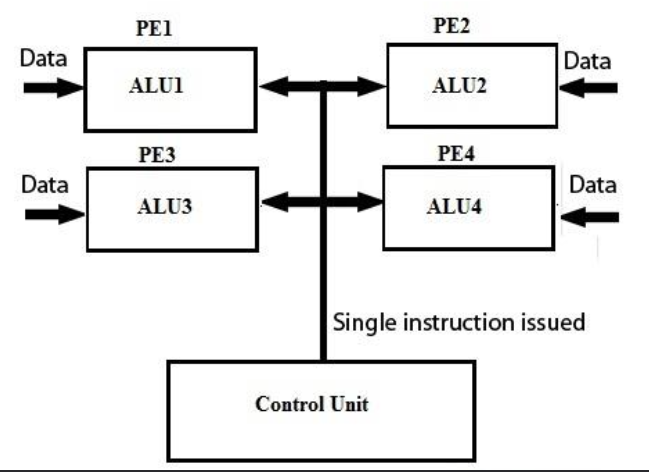
Each PE in an array consists of an ALU, local memory and other necessary components.
Data is loaded into the PEs from the main memory, and after processing, results are stored back. Each PE gets a contiguous chunk of data of size .
; Each PE runs this loop on its local chunk of the arrays.
; y[i] = c * a[i] + b[i], with c in r5, &a in r6, &b in r7 and &y in r8.
mov r1, #0                 ; r1 is the loop index
mov r2, #16                ; r2 is the loop limit (16 elements per PE)

loop:
  ldr r3, [r6, r1, lsl #2] ; r3 = a[i]
  ldr r4, [r7, r1, lsl #2] ; r4 = b[i]
  mul r3, r3, r5           ; r3 = c * a[i]
  add r3, r3, r4           ; r3 = c * a[i] + b[i]
  str r3, [r8, r1, lsl #2] ; y[i] = r3
  add r1, r1, #1           ; increment the loop index
  cmp r1, r2               ; check if we've reached the loop limit
  bne loop
Vector architectures
Section titled “Vector architectures”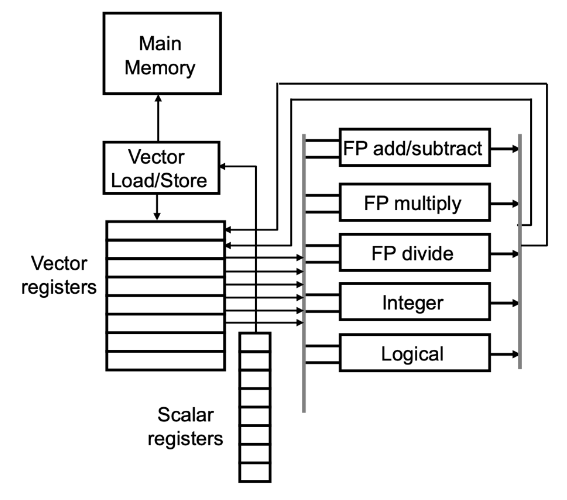
Vector architectures rely on vector registers, with vectorized/pipelined functional units.
Vector instructions allow leveraging memory bandwidth, since vector registers can be filled with a single instruction that can fetch up to 128 bits of data.
; Vectorized version of the same loop, 4 elements per iteration.
; c is in r5 (broadcast to all lanes), &a in r6, &b in r7 and &y in r8.
mov r1, #0                 ; r1 is the loop index
mov r2, #4                 ; r2 is the loop limit (4 vectors of 4 elements)
vdup.32 q3, r5             ; q3 = {c, c, c, c}

loop:
  vld1.32 {q1}, [r6]!      ; q1 = a[i..i+3]
  vld1.32 {q2}, [r7]!      ; q2 = b[i..i+3]
  vmul.f32 q1, q1, q3      ; q1 = c * a[i..i+3]
  vadd.f32 q1, q1, q2      ; q1 = c * a[i..i+3] + b[i..i+3]
  vst1.32 {q1}, [r8]!      ; y[i..i+3] = q1
  add r1, r1, #1           ; increment the loop index
  cmp r1, r2               ; check if we've reached the loop limit
  bne loop
Issues of SIMD architectures
Section titled “Issues of SIMD architectures”Vector architectures load data in chunks into registers. If the memory access patterns are irregular or inefficient, this can lead to performance degradation.
- Non-contiguous memory access: when data is scattered across memory, we may get cache misses, more memory accesses, and thus a higher latency. Array processors solve this with pipelining.
- Strided memory access: same as above, when there is a fixed gap between data and it is not aligned to the size of the vectors, we lose performance.
- Memory alignment: some architectures may require multiple loads/stores if the values in memory are not aligned to 16- or 32-byte boundaries.
Branch divergence is another problem with shared control units, since each PE must execute the same instruction and must idle while the other branch executes.