Deadlock prevention and detection methods
Deadlocks
Section titled “Deadlocks”A set of threads is in a deadlocked state when each one is waiting for an event that can be caused only by another thread in the set.
Deadlocks can arise if four conditions hold simultaneously:
- mutual exclusion: only one thread at a time can use a resource;
- hold and wait: a thread holding at least one resource is waiting to acquire additional resources;
- no preemption: a resource can be released only voluntarily by the thread holding it;
- circular wait: in a set of threads of waiting threads, is waiting for a resource held by , is waiting for and so on until is waiting for .
Resource-allocation graph
Section titled “Resource-allocation graph”Deadlocks can be described in terms of a graph called ‘resource-allocation graph’.
The graph is composed of a set of vertices and a set of edges . is partitioned into , the set of all threads in the system, and , the set of all resource types in the system.
A request edge is a directed edge that indicates that has requested an instance of . An assignment edge is a directed edge that indicates that an instance of has been allocated to .
Once the request is fulfilled, the request edge is immediately transformed into an assignment edge.
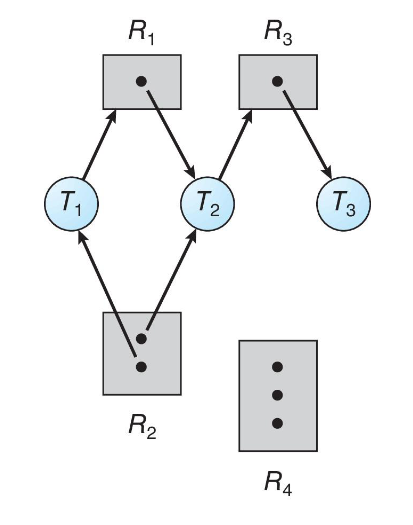
If there are cycles in the graph, then there is the possibility that deadlocks could manifest. If there is only one instance per resource type in the cycle, then the deadlock is guaranteed.
Deadlock handling
Section titled “Deadlock handling”Allowing the system to enter into a deadlock state and then recovering is difficult, mainly because deadlock detection is a tricky subject.
The easier method is to ensure that the system never enters the deadlock state.
Deadlock prevention
Section titled “Deadlock prevention”To prevent deadlocks we must invalidate one of the four conditions defined before:
- Mutual exclusion: avoid exclusive access to resources, making them shareable when possible (read only threads can run concurrently).
- Hold and wait: try to acquire all resources at once or immediately free the subset that was successfully taken.
- No preemption: while the thread is not running, it must release all the resources that it’s holding. Often impractical to implement.
- Circular wait: assign a global order to resources. Threads must acquire them in that order, preventing request cycles.
Deadlock avoidance
Section titled “Deadlock avoidance”Deadlock avoidance works when the programmer is collaborative and limits itself to satisfying the conditions required to avoid at least one of the four conditions.
If we could require additional a priori information about how resources are requested, then the OS can step in and help with avoiding deadlocks.
A deadlock-avoidance algorithm dynamically examines the resource-allocation state to ensure that there can never be a circular wait condition. The resource-allocation state is defined by the number of available and allocated resources, and by the maximum demands of the processes.
Thread-safe state
Section titled “Thread-safe state”When a thread requests an available resource, the system must decide if immediate allocation leaves the system in a safe state.
The system is in a safe state if there exists a sequence of all the threads in the system such that for each , the resources that can request can be satisfied by the available resources or the resources held by all the .
- If ’s resource needs are not immediately available, can wait until all finish.
- When all are finished, can obtain the needed resources, execute, return those resources, and terminate.
If a system is in a safe state, then it is guaranteed that deadlocks will not occur. Otherwise, they may or may not occur.
Claim edges
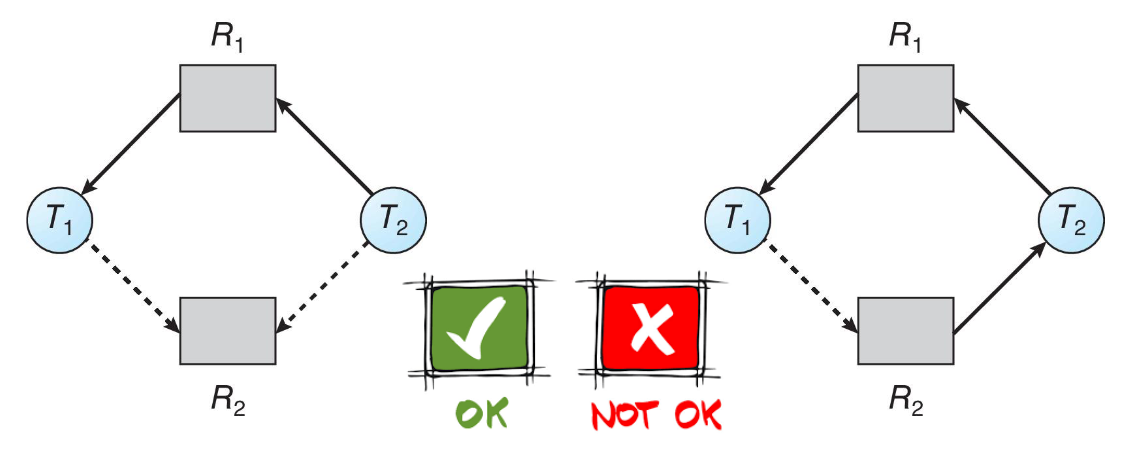
Section titled “Claim edges”In the resource-allocation graph scheme, claim edges from to indicate that the thread may request an instance of the resource during its execution.
The claim edge converts to a request edge when the thread actually requests the resource.
The request can be granted safely only if converting the request edge to an assignment edge does not result in a cycle.
Banker’s algorithm
Section titled “Banker’s algorithm”- Threads are seen as customers who can request credit from the bank (up to a priori declared limit).
- Resources are money. The bank cannot lend them all at the same time or it would fail.
Data structures (: number of processes, : number of resource types):
available: vector of length . Ifavailable[j] = kthere are instances of available.max: matrix. Ifmax[i, j] = k, then may request at most instances of .allocation: matrix. Ifallocation[i, j] = k, then is currently allocated instances of .need: matrix.need[i, j] = max[i, j] - allocation[i, j]. Ifneed[i, j] = k, then may need more instances of to complete its task.
Deadlock detection
Section titled “Deadlock detection”Deadlock detection allows the system to enter a deadlocked state. Then the OS uses a detection algorithm and a recovery scheme.
Single instance of each resource type
Section titled “Single instance of each resource type”In a system where there is a single instance of each resource type, we can keep an additional “waiting-for” graph.
Periodically we invoke an algorithm that searches for cycles in the graph. The presence of a cycle implies that the system is deadlocked. This algorithm requires operations, where is the number of vertices in the graph.
Multiple instances of each resource type
Section titled “Multiple instances of each resource type”We need 3 structures:
available: a vector of length that indicates the number of available resources of each type;allocation: an matrix that defines the number of resources of each type that are currently allocated to each thread;request: an matrix that indicates the number of resources being requested by each thread;
The algorithm for detection is the following:
Let
workandfinishbe vectors of length and respectively.They are initialized as:
work = availablefinish[i] = allocation[i] != 0
Find an index
isuch that both:finish[i] == falserequest[i] <= work
If not found go to step 4.
work += allocation[i]andfinish[i] = true. Then return to step 2.If any
finish[i] == false, then the system is in a deadlock state. Iffinish[i] == false, then is a deadlocked thread.
Recovery
Section titled “Recovery”The first kind of strategy that could be used to exit from a deadlock state is the termination of the deadlocked threads. We could choose to abort all of them or only some until the cycle is eliminated.
Problems: aborting could leave the system in an inconsistent state, and it is difficult to choose the right order in which threads should be aborted.
Another strategy is resource preemption. If we can successfully preempt some resources and give them to other processes, then the deadlock cycle could be broken.
Problems: it is still difficult to choose the thread whose resources should be preempted, as well as the risk of starvation, since a thread may always be chosen as the victim.