Memory performance: caching, SIMD and prefetching
Memory performance
Section titled “Memory performance”CPU compute speed far outpaces DRAM access latency, so on memory reads the CPU stalls for hundreds of cycles.
Two mechanisms are used to improve performance: caching and overlapping memory transfers with active computations.
Row-major vs column-major access
Section titled “Row-major vs column-major access”Row-major access matches how array elements are stored in C, so they lie in a contiguous block of memory and are accessed sequentially without jumps.
Column-major access reads elements in a non-contiguous way, reducing the number of cache hits and thus resulting in poorer performance.
From scalar processing to SIMD
Section titled “From scalar processing to SIMD”A simple for loop fetches one element of the array at a time and puts it into a CPU register. Then it usually applies an operation and writes the result back to memory. This requires sequential loop operations for elements.
void vec_add_scalar(float* A, float* B, float* C, int N) {
  for (int i = 0; i < N; i++) {
    C[i] = A[i] + B[i];
  }
}
SIMD instructions allow the compiler to vectorize the loop. The CPU can fetch multiple elements in one instruction, stored in a larger register, and then apply the same operation to each of them simultaneously.
void vec_add_simd(float* A, float* B, float* C, int N) {
  for (int i = 0; i < N; i += 8) {
    __m256 a = _mm256_load_ps(A + i);
    __m256 b = _mm256_load_ps(B + i);
    __m256 c = _mm256_add_ps(a, b);
    _mm256_store_ps(C + i, c);
  }
}
This still has the problem of stalling the CPU while data is fetched into registers, but the compiler can reorder instructions to keep the CPU busy while the data is being fetched:
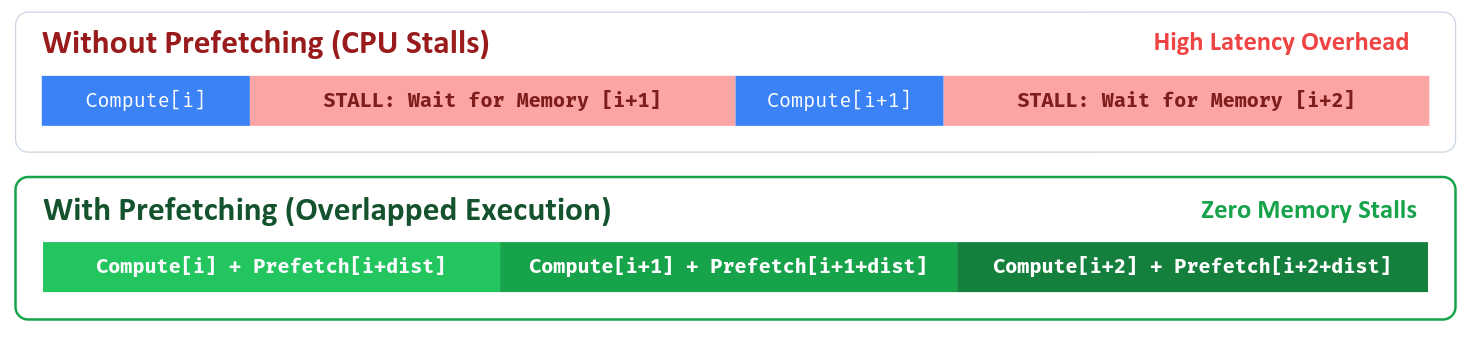
Prefetching can also be issued explicitly from the code:
void vec_add_simd_prefetch(float* A, float* B, float* C, int N) {
  for (int i = 0; i < N; i += 8) {
    int pf = i + PFDIST_ELEMS;
    // Prefetch data into all cache levels.
    _mm_prefetch((char*)(A + pf), _MM_HINT_T0);
    _mm_prefetch((char*)(B + pf), _MM_HINT_T0);

    __m256 a = _mm256_load_ps(A + i);
    __m256 b = _mm256_load_ps(B + i);
    __m256 c = _mm256_add_ps(a, b);
    _mm256_store_ps(C + i, c);
  }
}