Robot paradigms, manipulator types, and kinematics
Robots
Section titled “Robots”‘Robot’ is a Czech word, ‘robota’, meaning ‘forced labour’. It was introduced by a playwright in the 1920s and became famous from science fiction publications.
A robot is a machine that can move and do some of the work of a person and is usually controlled by a computer.
Some common abilities of robots are:
- Estimating their position (or more generally their current state) in the environment.
- Sensing the environment and creating a map.
- Taking a decision based on their current knowledge.
- Taking an action to implement the decision.
Intelligence
Section titled “Intelligence”The intelligence of the system is concentrated in two different aspects:
- perception of the surrounding environment and of itself in the environment;
- decision of what to do and how to do it;
Deliberative paradigm
Section titled “Deliberative paradigm”The deliberative paradigm is a top-down philosophy where the robot senses the world and constructs an updated model of the environment, then plans a course of action and implements the plan.
All the decisions are taken after a thorough deliberation procedure, so planning is prominent since we will not make corrections before the next sensing operation.
Due to the increased complexity required to preventively avoid all problem sources, the system needs to process a lot of data and is therefore quite slow.
Reactive paradigm
Section titled “Reactive paradigm”In the reactive paradigm, every action taken by the robot is an immediate response to sensed data. The system stores several sensing/reaction pairs that operate concurrently.
The robot has no memory; it merely executes in reaction to what it senses in the environment, so specific conditions may cause it to deviate from its intended course.
Hybrid paradigm
Section titled “Hybrid paradigm”In the hybrid paradigm, the robot plans how to best decompose a task into subtasks and then calculates which behaviours are suitable to accomplish each subtask.
The subtasks execute as in the reactive paradigm, allowing the robot to react to local problematic situations.
Modelling robots
Section titled “Modelling robots”Modelling robots means creating a mathematical representation of the environment in which the robot operates and of the reactions it has to take.
The representation has to be mathematical to obtain reliable and predictable behaviour.
Terminology
Section titled “Terminology”- Manipulators
- robots with a fixed base, made to mechanically manipulate things (treated in this course).
- Mobile robots
- robots with a mobile base.
A robotic manipulator consists of an arm ensuring mobility, a wrist located at the end of the arm and an end-effector executing the robot’s tasks.
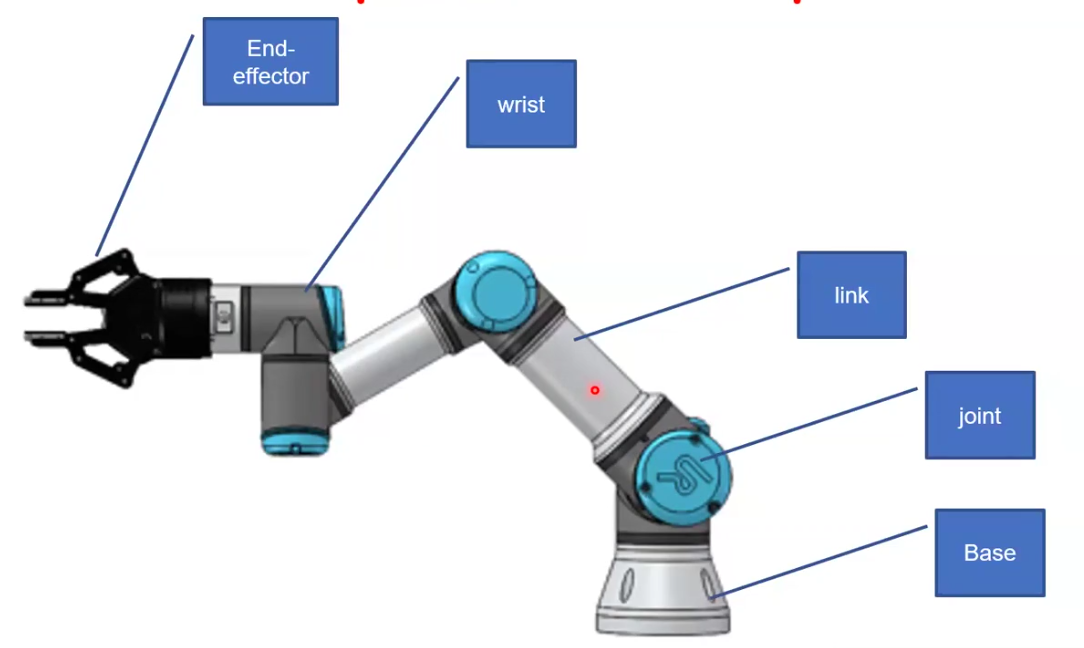
Joints provide the structure with its necessary mobility. They can be of two types:
- prismatic joints: enable a relative translational motion between the links (e.g. a telescopic arm that extends);
- rotational joints: enable a relative rotational motion between the links (e.g. those in the wrist);
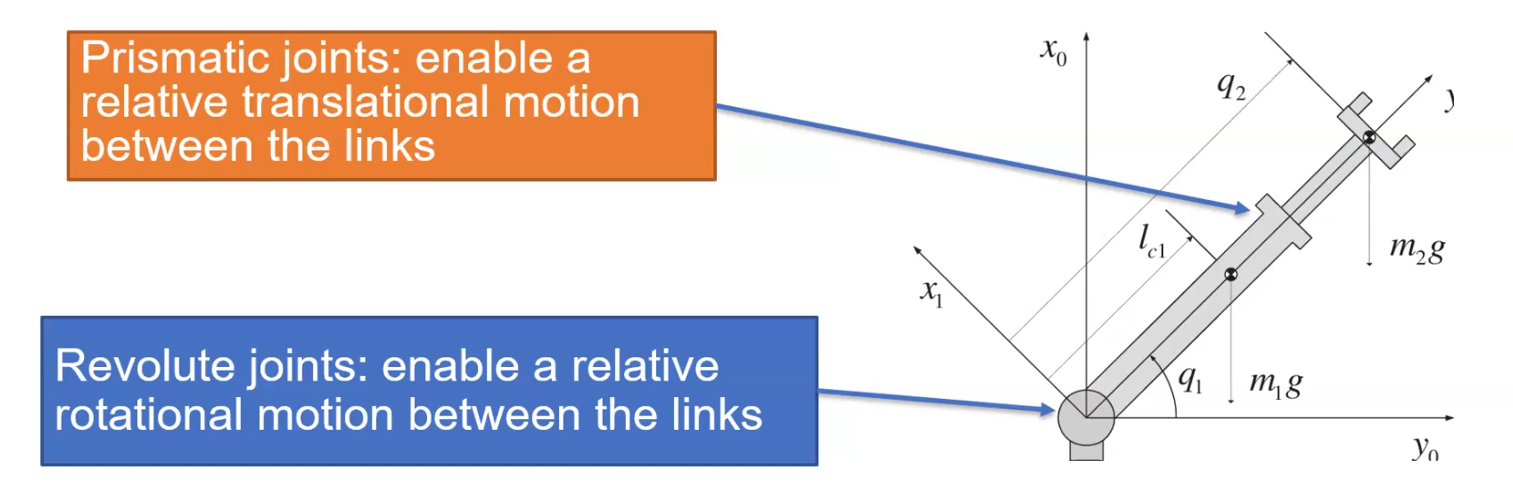
- Degree of freedom (DoF)
- Defines a specific mode in which the robot can move. Typically each joint is endowed with an actuator and provides the structure with one degree of freedom.
- Dexterity
- A robot’s ability to cope with a variety of objects and actions.
- Stiffness
- Ability of a body to resist deformation. In the robot’s case it indicates the amount of force required to induce an (unwanted) motion along a DoF.
The workspace of a robot is the set of all the points that can be reached by the end-effector.
Types of arms
Section titled “Types of arms”Cartesian manipulator: characterised by three prismatic joints, with three mutually orthogonal axes. The workspace is a parallelepiped.
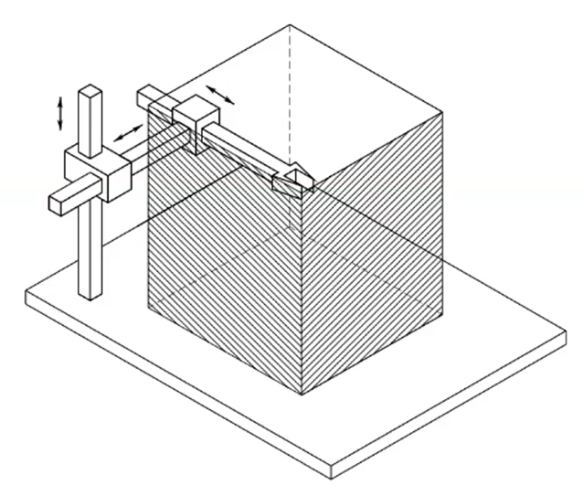
It operates with good mechanical stiffness and accuracy everywhere in its workspace, but its structure limits its dexterity.
Cylindrical manipulator: one of the joints is replaced by a revolute joint. The workspace is a portion of a cylinder.
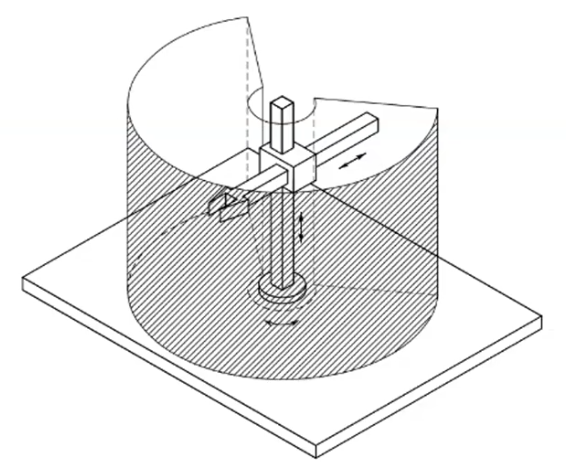
Good stiffness, but the wrist’s accuracy decreases with the horizontal stroke.
Spherical manipulator: two prismatic joints are replaced with revolute joints. The workspace is a portion of a hollow sphere.
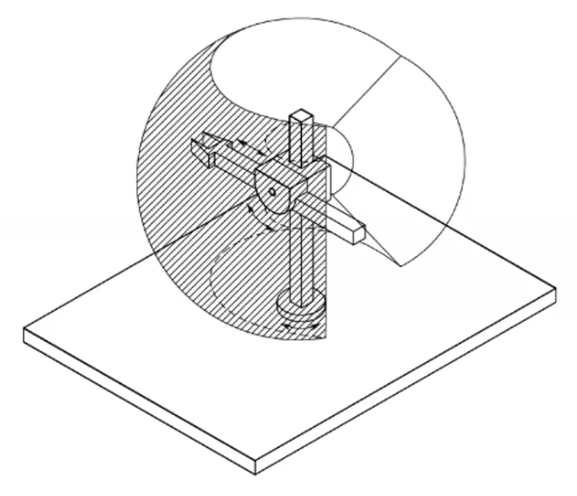
The manipulator has reduced accuracy when the radial stroke increases.
SCARA manipulator: two revolute joints and one prismatic joint.
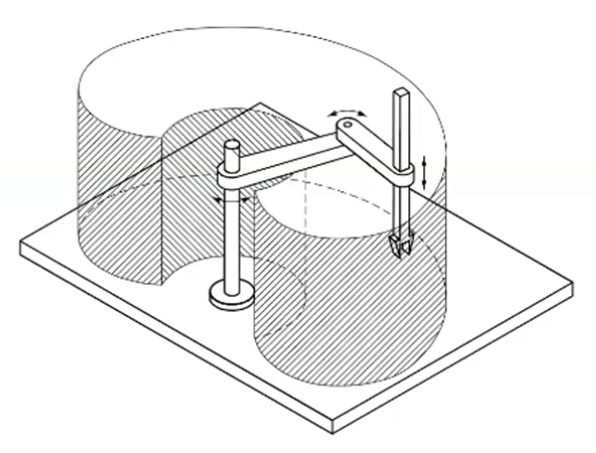
It has high stiffness under vertical loads. The positioning accuracy decreases with the distance from the first axis.
Anthropomorphic manipulator: three rotational joints. The axes of the second and third joints are orthogonal to the axis of the first.
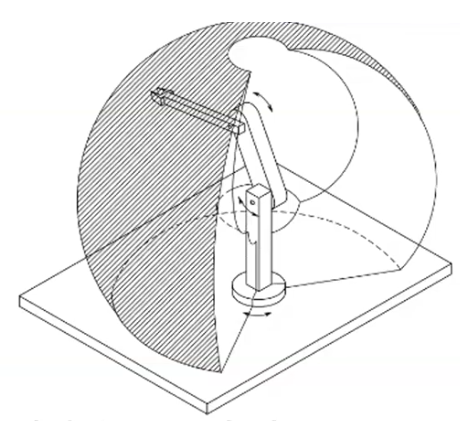
This is the robot with the most dexterity, but the accuracy varies depending on the position in the workspace.
All the different manipulators have an end-effector attached to a wrist. The configuration of the wrist that maximises dexterity is spherical (three revolute joints).
Mobile robots
Section titled “Mobile robots”A mobile robot is characterised by a mobile base.
- Wheeled robots
- they have a rigid body (chassis) and a system of wheels that provide motion with respect to the ground.
- Legged robots
- they move through the movement of multiple rigid bodies connected through revolute and sometimes prismatic joints.
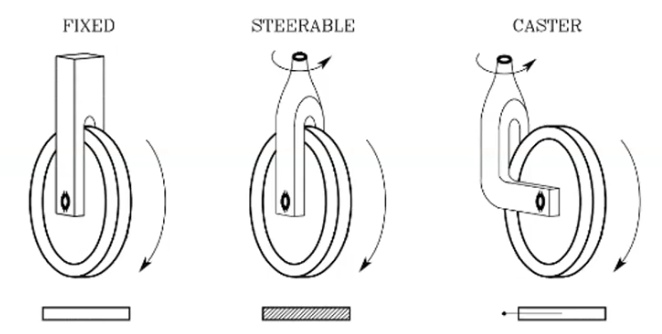
Wheeled robots use three types of wheels:
- Fixed: only the wheel rotates;
- Steerable: the wheel can steer around a vertical axis that passes through its middle;
- Caster: the vertical steering axis is offset from the centre of the wheel;
- Differential drive robots have two actuated wheels on the same axis (and a third caster wheel for stability). The robot can rotate by applying a different velocity to the two wheels.
- Tricycle robots have two fixed wheels actuated by a motor; a third wheel is steerable and is governed by another motor.
Unlike manipulators, mobile robots don’t have a limited workspace; however, they do have motion constraints (e.g. a differential robot cannot move sideways).
Geometric background
Section titled “Geometric background”Consider a robot arm fixed to a point.
The position of the point (forward kinematics) is given by the following:
For the inverse kinematics we use:
Wikipedia: Atan2