Operating system architecture and process memory
Operating system structure
Section titled “Operating system structure”For a simple example, let’s examine the architecture of MS-DOS.
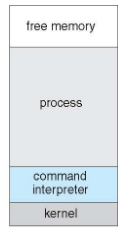
The OS was single-task oriented. After boot, a shell was loaded, and running a program was a very simple process. It lacked processes in the modern sense; programs were loaded directly into memory, overwriting everything except the kernel.
Monolithic
Section titled “Monolithic”The original UNIX employed a monolithic kernel structure. This structure integrated system programs with the kernel, which provided services such as file system (FS), scheduling, and memory management.
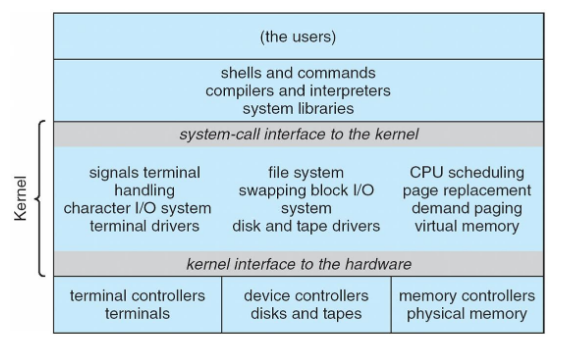
A monolithic kernel offered the advantage of being fast and energy efficient, but its lack of modularity necessitated a complete recompile every time an update was available.
More recent versions of Linux manage to split the kernel into subsystems, separating them by function and by proximity to the hardware.
Microkernel
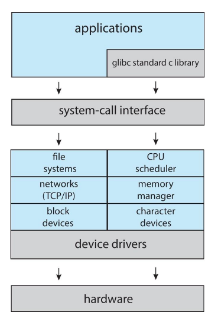
Section titled “Microkernel”The microkernel aims to minimize the code running in the kernel space by implementing as much functionality as possible in userspace.
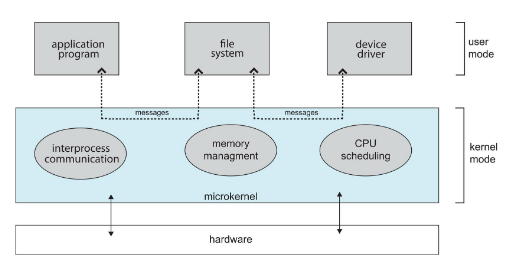
Its advantages include easier extensibility, simpler portability to new architectures, and enhanced security due to the reduced amount of code running in privileged mode. The primary drawback, however, is the performance overhead associated with increased communication between the kernel and userspace.
Modular OS
Section titled “Modular OS”Modern OSs implement loadable kernel modules (LKMs). This is analogous to a microkernel where the core kernel handles only basic message passing and process management, but modules run in kernel mode rather than userspace, mitigating the performance disadvantage.
With LKMs, the kernel’s behavior can be modified even while the system is running.
OS booting
Section titled “OS booting”When power is applied to the system, the CPU begins execution at a fixed memory address, which typically points to a small piece of code stored in ROM.
This initial code, the BIOS on legacy systems or UEFI on modern ones, can read disks and load another piece of software known as the bootloader.
The bootloader then locates the kernel image on the disk, usually by referencing a configuration file, and loads it into memory.
Processes
Section titled “Processes”An OS executes a variety of programs. Batch systems execute jobs sequentially as quickly as possible, while time-shared systems execute interactive user programs or tasks.
A program is a passive entity stored on the disk (the executable file); a process is the active instance of that program. A program’s execution can be initiated either by the user or automatically by the system.
A single program instance can spawn multiple processes (e.g., multiple windows open or multiple users running it concurrently).
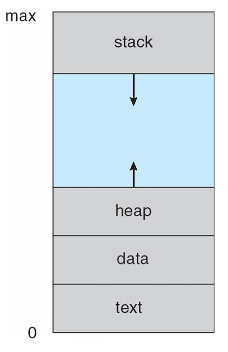
The memory utilized by a process is subdivided into specific regions:
- Text Section: Contains the program code. It is loaded at process start, though dynamic libraries may be loaded later.
- Data Section: Stores global variables and data initialized at compile time. These values can be pre-initialized in the executable file or initialized immediately after startup (BSS segment).
- Stack: Holds temporary data, such as local variables and function parameters, and is dynamically allocated as memory demands change.
- Heap: Holds data that is explicitly requested in RAM using functions like
malloc, which is dynamically allocated.